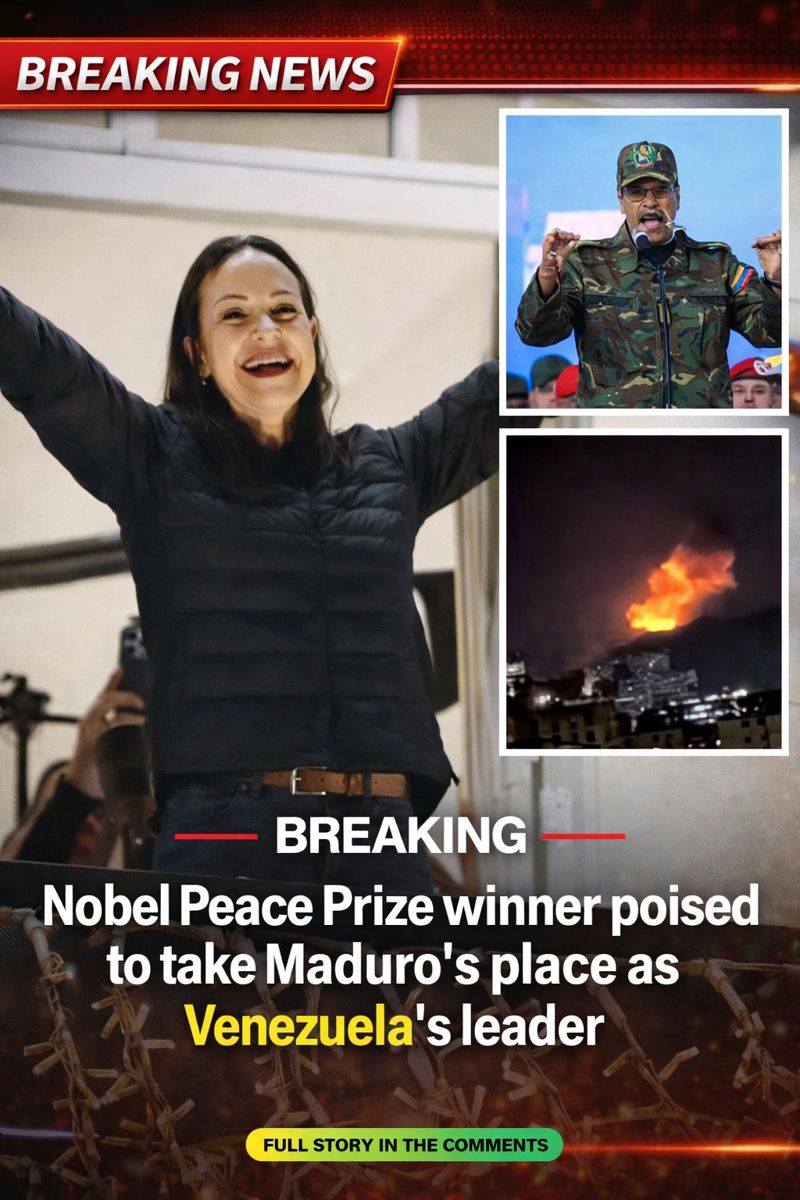
For years, María Corina Machado was not expected to prevail—least of all under conditions designed to exclude her. Barred from the ballot and repeatedly targeted by the state, she was pushed to the margins of formal politics. Yet in the wake of Venezuela’s latest upheaval, she has re-emerged at the center of a moment that feels both historic and unresolved.
The shift followed a cascade of reports and claims involving Nicolás Maduro and heightened international pressure that unsettled Caracas. Details remain contested and difficult to verify, but the effect inside the country was unmistakable: power suddenly looked less fixed than it had in years. In that opening, attention moved toward new figures—and new images—of authority.
Machado appeared alongside Edmundo González, their raised hands signaling unity at a time when fragmentation has long been Venezuela’s curse. González has been recognized by Washington and several allies as the country’s legitimate president, a position that carries diplomatic weight even as its practical reach remains uncertain. Machado, once erased from the race, now stands amplified—yet still constrained by the realities on the ground.
What confronts them is not a clean slate, but a nation marked by years of blackouts, mass exile, economic collapse, and fear. Any transition, formal or informal, would begin under strain. Hope has returned for many Venezuelans, but it is cautious—tempered by memory and loss.
A prospective transitional leadership would face immediate tests: whether reconciliation can proceed without vengeance; whether former regime supporters can be reintegrated into civic life without reigniting conflict; and whether institutions hollowed out by years of pressure can be stabilized rather than replaced by new forms of exclusion.
Beyond politics, there are harder constraints. Streets restless with expectation. An economy deeply damaged. And powerful military and security figures whose loyalties cannot be assumed. In Venezuela, legitimacy has often failed not at the ballot, but in the space between promise and enforcement.
For millions, this moment holds both promise and peril. Success could mark the beginning of repair—slow, imperfect, and demanding restraint. Failure could deepen instability and fracture what remains of social trust.
History offers no guarantees here. Change, when it comes, rarely arrives whole. It tests not only resolve, but patience. What matters now is not symbolism alone, but whether leadership can resist the gravity of revenge, honor process over impulse, and place the long work of rebuilding above the immediate rush of triumph.
The future will be decided not in raised hands or recognition statements, but in whether ordinary Venezuelans begin to see order replace exhaustion—and whether power, once unsettled, can be returned to institutions rather than personalities.