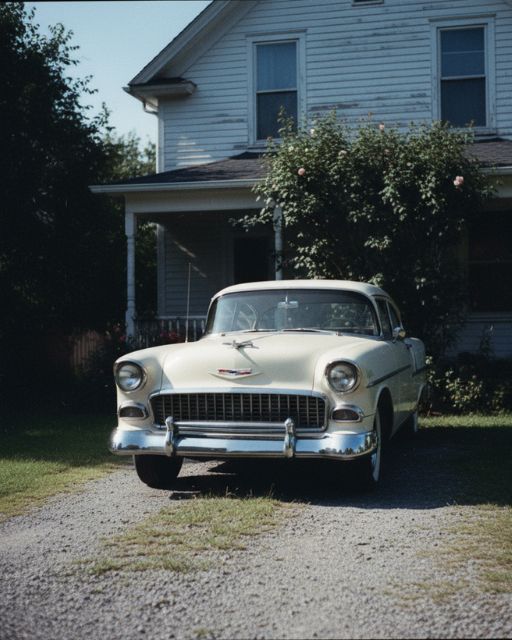
Everyone in town said the place was abandoned. The paint peeled, weeds swallowed the porch, and its windows had been boarded up since the fire — the one no one in my family ever talked about.
Then one morning, I saw it: a cream-colored ’55 Chevy, spotless, gleaming like it had rolled straight out of a time machine. Behind the wheel sat someone I hadn’t seen in 17 years — my uncle Victor, the man who disappeared the same night as the fire.
“Kiddo,” he said casually, as if no time had passed.
I froze. “Uncle Vic? What the hell are you doing here?”
He smiled. “Making sure the roof hasn’t caved in.”
The house still stood, half-charred and rotting, but no one dared go near it. The fire had taken my father’s life — and Victor’s disappearance had always felt like an answer no one wanted to say out loud.
Inside, the air reeked of ash. Dust floated like ghosts. Victor crouched near a burned beam, prying up floorboards until he pulled out a scorched metal box. Inside were stacks of cash and a Polaroid of him and Dad, grinning in front of that same Chevy.
My chest tightened. “What is this?”
His voice cracked. “The truth. Your dad and I weren’t saints. I dragged him into running money with me. That night, men came to collect. He tried to stand his ground. He didn’t make it. And I… I ran.”
The words hollowed me out. For years, I thought Dad’s death was an accident. Now I knew it was tied to secrets — and Victor’s guilt.
“Why now?” I whispered.
“Because it’s time you knew. And because those men are gone.”
We didn’t fix everything with one conversation, but we started. Using that money, we rebuilt part of the house — the porch where Dad once played guitar. Neighbors helped, and slowly the place became something more than a scar.
At the first gathering, stories of my dad filled the night air — his laugh, his kindness, his music. Not the fire. Not the debts. For the first time, the house felt alive again.
And I understood: forgiveness isn’t about erasing the past. It’s about deciding the story doesn’t end there.