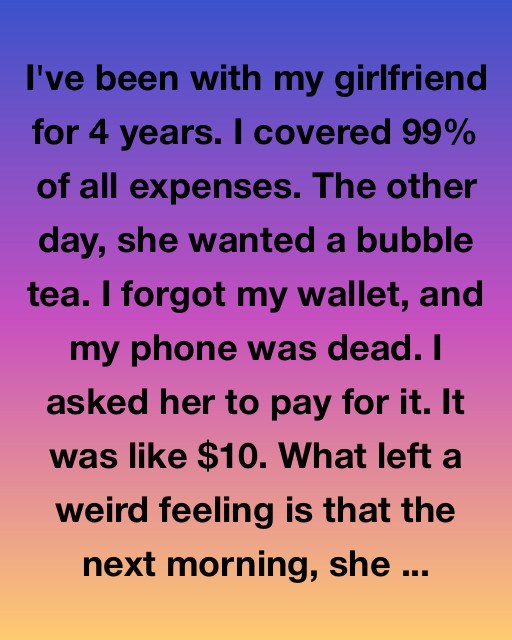
I’d paid for almost everything for four years—rent, trips, dinners, little luxuries—because that’s what love looked like in the house I grew up in: show up, take care, don’t keep score.
Then came the bubble tea.
We were out, I’d forgotten my wallet, phone dead, ten bucks short. I asked her to grab it. She did. The next morning, she “joked” about me owing her—twice. The second time was in front of a friend: “Can you believe I had to pay for my own bubble tea?” Laughter. Mine included, delayed. Something small and sharp lodged under my ribs.
I tested it the next day. At a café, I didn’t reach for the check. She laughed: “Forgot your wallet again?”
“No,” I said. “Thought maybe you’d get it this time.”
A pause. “I thought you liked paying.”
“I like being appreciated more.”
The air thinned. She paid, frowning. I didn’t lecture; I let the data gather—cheaper dates, no surprise gas top-ups, her Uber rides. She noticed. “Is everything okay?”
“Just thinking about balance.”
“You make more than me. Isn’t that part of the deal?”
I had no answer for a deal I never signed.
Her birthday came. I’d usually go big. Instead, I brought flowers and a small photo book I made. She smiled, then asked, “Is this it?” Honest, not cruel—it showed what had been humming beneath the surface: she lit up for purchases more than for me.
Then the layoffs hit. I had savings and a plan, but the first night she hugged me, made tea. By week two, she visited less. Week three: “I feel like his mom,” she said. She hadn’t paid for dinner once.
I stopped calling. Three days later: “You okay?”
“I think we need a break,” I wrote back.
“So now you’re pushing me away because you’re broke?”
She showed up, angry and afraid. “You’re throwing away four years over money?”
“It’s not money,” I said. “It’s the moment I needed a hand and you made me feel small.”
We talked for hours. She cried. She said she panicked, didn’t know how to be supportive. I believed her. But some truths, once seen, don’t unsee.
In that quiet, I rebuilt: therapy, running, freelance work that gained momentum. Slowly, she learned to contribute without announcing it. A box arrived one day: cookies, Epsom salts, a note—for the man who carried so much. I cried.
We tried again, slowly. Splitting dates, long walks, fewer promises, more patterns. That ten-dollar drink? It wasn’t about the drink. It was about balance, presence, humility, repair.
Relationships aren’t 50/50. They’re 100/100, each bringing their whole selves. Everyone has a bubble tea moment. What matters is who you become after it.