The Box She Left Behind
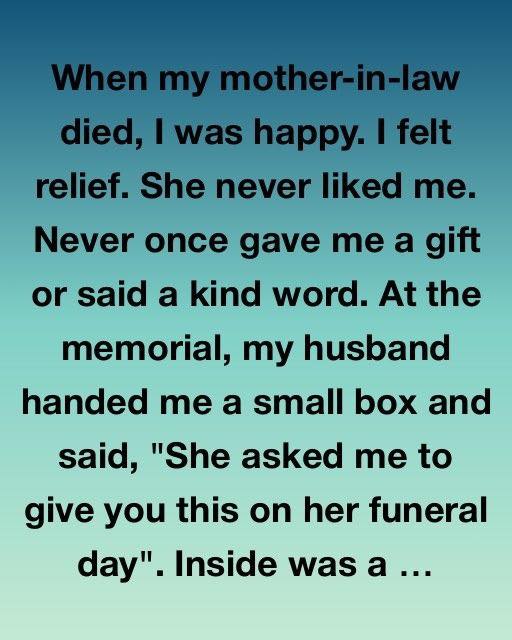
When my mother-in-law passed away, I felt something I hadn’t expected: relief. She had never liked me. Not once had she offered a kind word or a thoughtful gesture. At her memorial, my husband handed me a small box and said, “She asked me to give you this today.”
Inside was a silver necklace I’d never seen before—a delicate teardrop pendant with a tiny sapphire. I blinked. “Are you sure this is for me?”
He nodded. “She was very clear. Said you should open it today. Alone.”
That word—alone—lingered. I waited until the house was quiet, our son asleep, the guests gone. Sitting on the edge of our bed, I studied the necklace. It looked vintage. On the back, etched faintly, were two initials: L.T.
My initials.
I couldn’t imagine how she’d come to own a necklace with my initials. Coincidence? Maybe. But curiosity tugged harder. I searched the box for a note. There it was—folded, with my name written in her unmistakable, sharp script.
I hesitated. Then opened it.
I stared at the page, stunned. She wasn’t the kind of woman who admitted fault.
I swallowed hard. My husband wasn’t like that. But maybe she saw shadows I didn’t.
My eyes blurred. I had spent years believing she was just bitter. Maybe she was. But this letter felt like something else—a reckoning.
That was the end. No signature. No goodbye. Just that.
I didn’t sleep much that night.
The next morning, I wore the necklace to breakfast. My husband looked surprised. “She gave you that?”
I nodded. “And a letter.”
He didn’t ask what it said. I didn’t offer. Not yet.
Days passed. My anger softened into confusion, then into something closer to grief.
A week later, we got a call from her lawyer. There was a reading of the will. She hadn’t left much—just the house, a modest savings, some jewelry.
Then the lawyer said, “She left a special clause for her daughter-in-law.”
That was me.
He handed me an envelope. “It’s a key,” he said. “And a note: ‘She’ll know what it’s for.’”
I didn’t. Not immediately.
But as soon as I held the key, I remembered a small attic door in her house. Years ago, before things soured, I’d asked about it. She’d snapped, “That room’s off limits.”
Now I understood.
We drove to the house. It felt quieter without her. The attic door was behind a faded curtain. The key fit perfectly.
Inside, the air smelled of cedar and dust. A trunk sat in the center. I opened it.
Journals. Dozens. Some leather-bound, others spiral notebooks. I pulled one out—dated 1973.
She had written everything. Her fears. Her loneliness. Her longing to paint. Her dream of Paris. Her regret.
One journal held a photo of a watercolor—a woman standing alone in a garden. On the back: Me, before I disappeared.
My throat tightened.
In another, she wrote about Lucas. Her parents’ disapproval. Letting him go. Keeping the necklace as a memory of who she’d been.
I spent hours in that attic.
I didn’t tell my husband everything. Just that she’d left behind journals. He didn’t press.
Weeks later, I did something unexpected. I submitted a painting—based on her journal photo—to a local art show. Under a fake name.
It was accepted.
People loved it. One called it “quietly heartbreaking.”
I submitted two more.
Then a gallery reached out. “Who’s the artist?”
I told them. “She was my mother-in-law. She passed recently. These were in her attic.”
They asked for more.
Soon, her work was in a real exhibit. Not huge, but meaningful. People cried in front of her paintings. Said they saw themselves in the quiet ache of her brushstrokes.
I wish she could’ve seen it.
Or maybe she knew. Maybe that’s why she left me the key.
Months later, another letter arrived. From the lawyer. A safety deposit box—only accessible by me.
Inside was a check.
$40,000.
And a note:
I cried like I hadn’t in years.
I used the money to open a small gallery downtown. A space for overlooked artists—especially older women—who never had the chance to be seen. I named it The Teardrop. After her necklace. After her.
It became more than I imagined. People came. Donated. Shared stories—women who gave up careers, painted in closets, felt invisible.
I saw her in all of them.
I realized she hadn’t hated me. She hated what life had taken from her. I was a mirror she couldn’t bear to face.
But in the end, she did.
She left me her regrets. Her art. Her truth. And in doing so, she gave me a purpose I hadn’t known I needed.
Funny how the people who wound us most can sometimes hand us our greatest healing.
It’s been three years.
The necklace still rests on my collarbone. The journals are archived in the gallery’s backroom, open to anyone who wants to know the woman behind the brush.
My husband visited once. He stood in front of that garden painting. “I never knew she felt this way,” he whispered.
Neither did I.
But now the world does.
And maybe that’s what matters most.
Sometimes, apologies come in strange forms—not in words, but in what’s left behind.
So if you’ve ever felt unwanted, or judged without reason, remember this: some wounds aren’t about you. Some cold hearts are just deeply bruised.
And sometimes, the harshest people carry the most fragile stories inside.
If this story touched you, share it. Someone out there might need the reminder: forgiveness doesn’t always arrive wrapped in a bow—but it can still set you free.