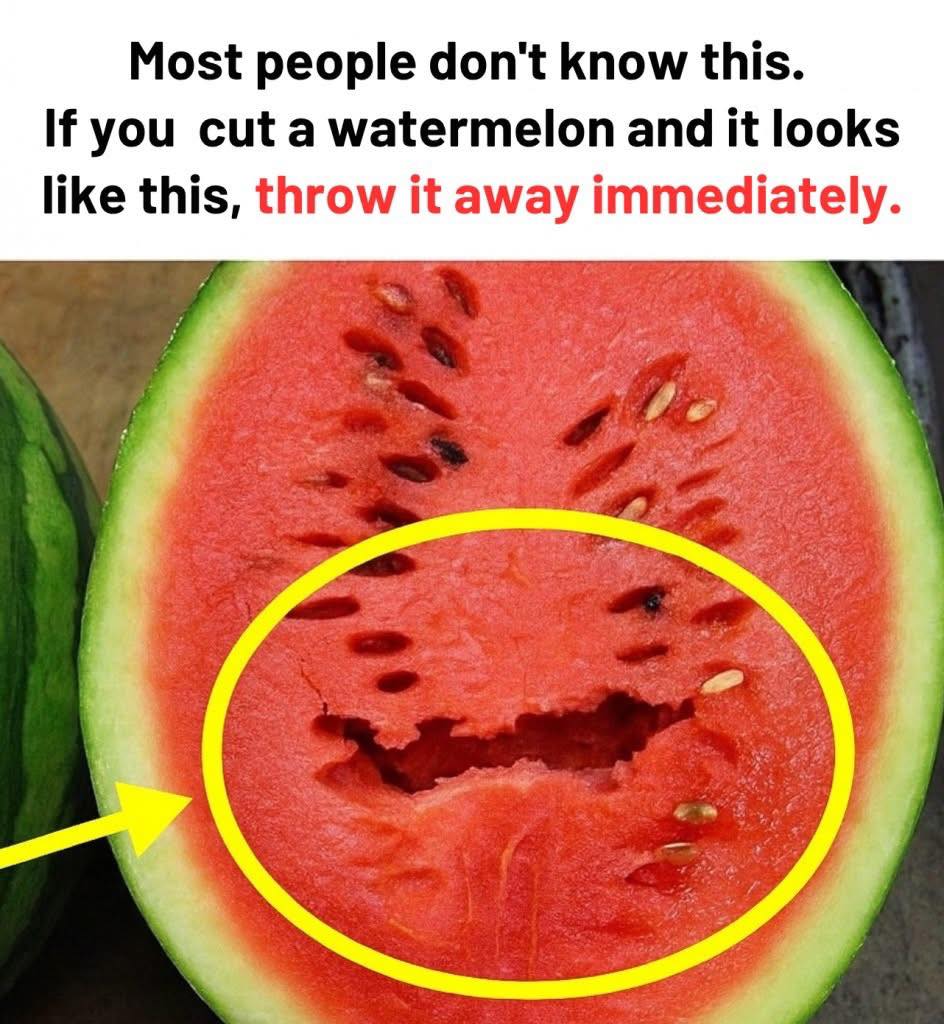
Why You Should Throw Away a Watermelon If It Looks Like This Inside
On a scorching summer day, few pleasures beat the crisp, juicy bite of a chilled slice of watermelon. But what happens when you finally cut into that perfectly green-rinded melon — only to find deep cracks, hollow pockets, or gaping splits running through the red flesh?
While a misshapen interior might seem like a harmless oddity, food safety experts say it could indicate a deeper issue — and in some cases, mean the fruit shouldn’t be eaten at all.
The condition you’re seeing is commonly known as “hollow heart” — a physiological disorder that causes internal fissures, cavities, or separation of the flesh within the fruit. Despite the name, it has nothing to do with the seeds or core — it’s a structural flaw that develops as the melon grows.
This condition isn’t caused by disease, but by stress during growth. Common triggers include:
 Fluctuating temperatures — sudden heatwaves or cold snaps during ripening
 Inconsistent watering — periods of drought followed by heavy irrigation
 Overuse of nitrogen-rich fertilizers — which push rapid growth the fruit can’t sustain
 Hybrid varieties — some modern watermelon breeds are more prone to this issue
When a watermelon grows too quickly on the outside while the inside lags, the flesh can pull apart, creating gaps and cracks that weren’t visible from the outside.
Here’s the hard truth: A watermelon with hollow heart isn’t automatically dangerous — but it’s risky.
Why?
- Increased Risk of Bacterial Growth
Those internal cracks create hidden pockets where moisture can collect — the perfect breeding ground for bacteria like Salmonella, Listeria, or E. coli, especially if the melon was exposed to contamination during handling or storage. - Hard to Detect Spoilage
Unlike surface mold, internal bacteria may not produce a foul smell or visible rot — especially in the early stages. By the time you notice something’s off, it might be too late. - Compromised Storage Integrity
If the melon experienced stress during growth or transport, its natural defenses may be weakened, making it more vulnerable to contamination — even if the rind looks perfect.
The USDA and food safety professionals emphasize a simple rule:
If the inside of a watermelon looks abnormal — especially with deep cracks or hollow areas — don’t eat it.
While the fruit may still be technically edible in some cases, the risk of foodborne illness isn’t worth the gamble — especially for children, the elderly, pregnant individuals, or anyone with a weakened immune system.
You can’t always prevent hollow heart, but you can reduce your risk by selecting your melon wisely.
 Look for a creamy yellow spot — this “ground spot” should be creamy, not white. It means the melon ripened on the vine. Choose a uniform shape — avoid melons with odd bulges or lopsidedness. Check the rind — it should be firm, smooth, and free of bruises, cuts, or soft spots. Give it a tap — a deep, hollow sound usually indicates ripeness (though not a guarantee of internal quality). Once cut, inspect the flesh — it should be firm, deeply colored, and free of gaps or mushy areas.
Hollow heart may start as a cosmetic flaw, but it can signal unseen vulnerabilities in your fruit. In the warm months — when bacteria multiply faster — taking a chance on a questionable melon could lead to stomach upset, food poisoning, or worse.
Deep cracks
 Stop. Don’t taste it. Just throw it away.