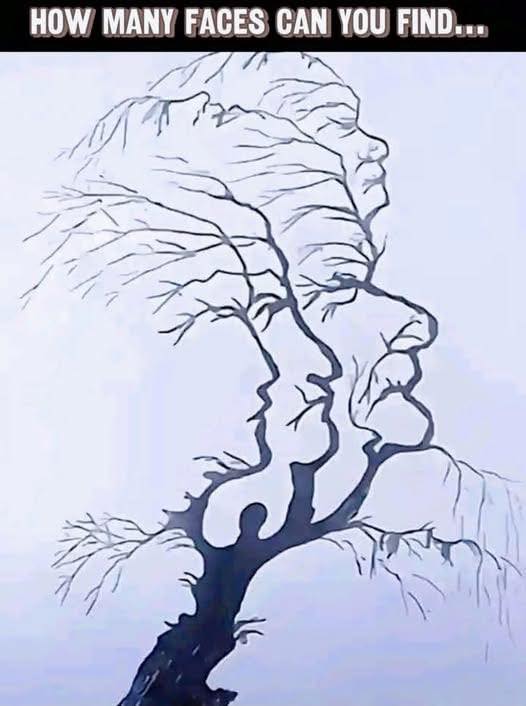
Find all hidden faces in the picture
How Many Hidden Faces Can You Spot in This Tree? Dive into Pareidolia and Brain-Boosting Illusions
Unpacking the Allure of Hidden Faces in Art and Nature
Have you ever glanced at a tree or a cloud and suddenly noticed a face staring back at you? That curious moment when your brain says, “Hey, that branch looks like a nose!” is called pareidolia, and it’s the magic behind this tree illustration packed with hidden profiles. In this article, we’ll explore why spotting faces in this optical illusion fascinates us, share strategies to uncover every concealed visage, discuss the cognitive perks of these brain teasers, and even guide you in crafting your own face-in-tree illusions. So, cozy up, and let’s wander down this winding path of branches and profiles together!

Why Our Brains Love Hidden-Face Puzzles
Have you ever wondered why you can’t resist scanning patterns for faces, even when you know deep down there’s no actual person hiding there? It’s not just superstition or a quirk—it’s rooted in evolution. Our ancestors needed to detect faces quickly (friend or foe?) at a glance. Over time, our brains became wired to err on the side of “face-seeing,” sometimes finding faces in clouds, rock formations, or, in this case, an illustrated tree. That instant “Aha!” moment triggers a mini dopamine rush, rewarding us for noticing something “secret.” These puzzles tap into that reward system, making us lean closer to the image, determined to find more hidden profiles. Plus, sharing “I found 7 faces!” ignites friendly competition and social bonding, fueling engagement and fun.
Decoding the Tree Illusion: How Many Faces Are Hiding?
At first glance, you see a tree trunk and branches stretching skyward. But look again: contours of the bark, twists in the branches, and undulating lines mimic facial features—profiles of different ages, expressions, and gazes. Maybe you spot a wise elder’s profile formed by thicker limbs, or a youthful silhouette hidden among finer twigs. The trick lies in noticing how negative space (the sky around the branches) and positive shapes (the dark trunk) interplay to reveal outlines of noses, lips, chins, and foreheads. To decode the illustration, start by tracing the main trunk’s curves: do they resemble a forehead-to-chin line? Then shift to secondary branches—could a forked limb double as split cheeks or an open mouth? Keep scanning, adjusting your perspective until each branch’s nuance resolves into a hidden face. Depending on the design, there might be anywhere from five to a dozen or more profiles. How many can you find?
Strategies to Spot Every Concealed Face
Instead of random glances, adopt a detective mindset. First, divide the image into zones: lower trunk, midsection, upper canopy. Tackle one area at a time so no corner escapes your gaze. Second, focus on silhouettes: temporarily ignore fine details and concentrate on the broad shape of a potential face—forehead slope, nose ridge, chin line. Third, flip your perspective: tilt your head, squint, or even view the image upside-down to see shapes you missed initially. Our brains often fixate on one pattern; changing vantage points breaks that fixation. Fourth, examine negative space: sometimes the “face” emerges in the gap between branches rather than in the dark areas. Finally, mark your finds—either mentally or by lightly outlining on a printout—so you know which profiles you’ve confirmed and which spots still need scrutiny. Celebrate each discovery: that little “Yes!” keeps motivation high as you hunt for more elusive faces.
The Science Behind Pareidolia: More Than Just Fun
Pareidolia isn’t merely a party trick—scientists study it to understand perception, pattern recognition, and even mental health. Our visual system excels at spotting familiar shapes quickly, often prioritizing speed over perfect accuracy. That’s why we might see a face where none exists: better safe than sorry. In neurological terms, areas like the fusiform face area respond to facial stimuli, even when those stimuli are illusory. Interestingly, engaging with pareidolia puzzles can sharpen pattern recognition skills, train our attention to detail, and even offer mild cognitive exercise. By regularly challenging ourselves to spot hidden shapes, we keep neural pathways active—like jogging for the brain. Plus, the emotional thrill of discovery or surprise can lower stress, offering a mini mindfulness break as we focus solely on the image.
Emotional and Social Benefits of Hidden-Face Puzzles
Beyond the mental workout, these illusions spark empathy and shared joy. When you share your face count with a friend or post your findings online, you invite conversation: “I saw 9 faces—did you spot the old man near the top?” This exchange builds community, encourages diverse perspectives (they might see a face you missed), and fosters playful competition. On an emotional level, taking a break to focus on a lighthearted puzzle can relieve anxiety, pulling you out of rumination loops. The moment of “Aha!” feels rewarding and can boost mood. In group settings—family gatherings, classroom activities—hidden-face puzzles become collaborative adventures, teaching patience and attentive observation in a fun environment.
Creating Your Own Face-in-Tree Illusions
Feeling inspired to design your own hidden-face artwork? Here’s a step-by-step guide:
Choose a Base Outline: Start with a simple tree silhouette—trunk and branching structure. You can sketch freehand or use digital drawing tools.
Map Potential Face Zones: Identify areas where branch shapes naturally align into profile-like outlines—curved trunk segments for forehead and nose, forked limbs for chin or jawline. Mark these lightly to guide your design.
Refine Branch Contours: Adjust branch thickness and curvature so edges hint at facial features without being too obvious. Subtlety is key: the challenge lies in near-misses that your brain resolves into faces.
Leverage Negative Space: Consider the background color or sky between branches. Faces can appear in those gaps as much as in the dark lines. Plan branch placements accordingly.
Incorporate Variety: Vary face sizes and orientations: side profiles, three-quarter views, even smaller hidden faces within larger ones. This layered approach increases puzzle depth.
Test with Fresh Eyes: Once your draft is ready, show it to friends without hints. Note which faces are found immediately and which remain hidden. Tweak contrasts or tweak branch curves to balance difficulty.
Finalize and Share: Present the illusion with a prompt—“How many faces can you find in this tree?” Provide a checklist reveal later so solvers can confirm their finds.
By crafting your own illusions, you deepen appreciation for the artistry and psychology behind pareidolia, and you create engaging content for blogs, social media, or classroom materials.
Applying Hidden-Face Puzzles in Education and Therapy
Teachers and therapists harness pareidolia challenges to sharpen observation skills and facilitate emotional expression. In art or psychology classes, students dissect how simple shapes evoke complex perceptions. Discussing why our brains see faces fosters critical thinking about perception vs. reality. In therapy, presenting ambiguous images (like a face-in-tree illusion) can open conversations: “What emotion do you feel when you spot the hidden profile?” This can lead to deeper self-awareness. Educators might use hidden-face puzzles to teach patience and focus: as students hunt for profiles, they practice systematic search strategies useful across subjects. The versatility of these illusions makes them powerful tools beyond entertainment.
Tips for Maximizing SEO and Engagement Around Hidden-Face Content
If you plan to publish an article or blog post centered on this tree illusion, integrate SEO best practices:
Keyword Integration: Naturally weave phrases like “hidden faces puzzle,” “pareidolia tree illusion,” “spot the faces in tree,” and “optical illusion brain teaser” into headings and content.
Engaging Headings: Use bold Markdown headings that directly address search intent: e.g., How to Spot Hidden Faces in Tree Illusions, Why Our Brains See Faces Everywhere, Create Your Own Pareidolia Artwork.
Conversational Tone: Speak directly to readers: “Have you tried tilting your head to spot that old face near the top branch?”; use personal pronouns to build rapport.
Multimedia Inclusion: Embed the tree illusion image (with proper alt text: “Tree optical illusion with multiple hidden faces”) so readers can interact immediately. If possible, provide an interactive version or print-friendly download.
Internal Linking: Link to related articles on optical illusions, cognitive exercises, or art tutorials to keep readers on your site longer.
Social Sharing Prompts: Encourage readers to share their face count on social media: “Tag a friend who loves brain teasers!” This generates backlinks and organic traffic.
Checklist Reveal: After readers attempt the puzzle, include a “Face Count Reveal” section with numbered outlines on the image, reinforcing completion and satisfaction.
By combining engaging content, SEO-savvy structure, and interactive elements, you boost your chances to outrank competing pages and delight your audience.

Deepening Your Appreciation: Beyond the Puzzle
While finding hidden faces is entertaining, it also invites reflection: what does it say about perception, creativity, and how we interpret the world? This tree illusion becomes a metaphor: sometimes, we project meaning onto random patterns—whether in nature, emotionally ambiguous situations, or complex social cues. Recognizing pareidolia helps us stay critical: just because we “see” something doesn’t mean it truly exists. Yet, the same tendency fuels imagination, artistic expression, and the joy of discovery. Embracing both sides—skepticism and wonder—enriches our experience of art and life.
Conclusion: Celebrate Curiosity and Keep Hunting for Faces
This intriguing tree illustration bristling with hidden faces reminds us that curiosity transforms the ordinary into an adventure. By training your eyes with systematic scanning, shifting perspectives, and exploring negative space, you uncover profiles that initially blend into bark and branches. Beyond the fun of spotting faces, engaging with pareidolia puzzles boosts cognitive skills, fosters social connection, and stimulates creative thinking. Whether you’re a puzzle enthusiast, an educator seeking interactive exercises, or an artist intrigued by illusions, these techniques and insights open new avenues for exploration. So next time you pass a tree, cloud, or abstract pattern, ask yourself: “How many faces can I find?” Let that playful inquiry guide you, and celebrate each “Aha!” moment as proof of your brain’s remarkable ability to see the unexpected. Happy face hunting!