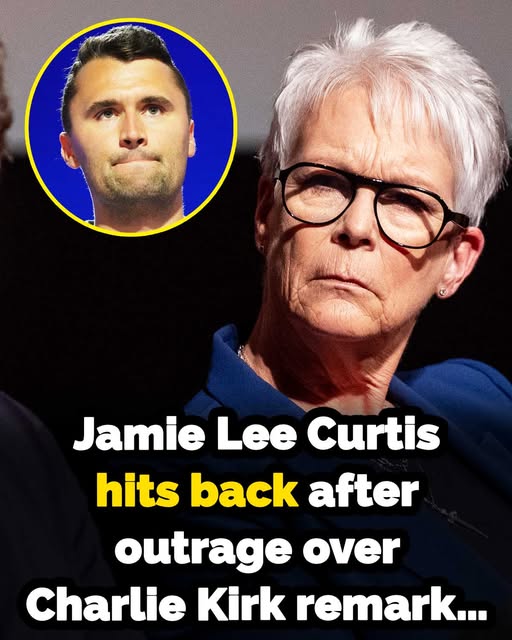

Jamie Lee Curtis Responds Following Backlash Over Charlie Kirk Remark
The shocking murder of Charlie Kirk sent ripples of grief and disbelief around the world. Among those visibly affected was acclaimed actress Jamie Lee Curtis, who openly expressed her sorrow over the tragic event. Speaking about the incident, Curtis became emotional, breaking down in tears as she described her reaction. Her heartfelt words struck a chord with many, but they also sparked significant backlash from others who disagreed with her perspective. Now, after days of silence, Jamie Lee Curtis has addressed the controversy surrounding her comments.
In the immediate aftermath of Charlie Kirk’s death, Jamie Lee Curtis was among the public figures who shared her reflections on the tragedy. While many responded with empathy, recognizing the human side of her remarks, others criticized her for seeming to sympathize with someone whose ideas they found deeply problematic.
During an appearance on the popular WTF with Marc Maron podcast, Curtis discussed her feelings in depth. She acknowledged that she had often disagreed with Kirk, saying, “I disagreed with him on almost every point I ever heard him say.” Despite that, she explained that she still viewed him as a man of faith. Curtis’s voice quivered with emotion as she added, “I hope in that moment when he died that he felt connected to his faith. Even though I found many of his ideas abhorrent, I still believe he was a father and a husband and a man of faith. And I hope that whatever connection to God means, he felt it in his final moments.”
Curtis’s reflections went further, as she recalled the trauma associated with violent imagery in media. She referenced both the events of 9/11 and the widely circulated footage of Kirk’s murder, emphasizing the psychological toll such repeated exposure can have on viewers. “Yesterday, we watched again these images of those buildings coming down. Today, we as a society are bombarded with imagery,” she said. “We don’t know what the longitudinal effects are of seeing those towers fall repeatedly, or of watching his execution over and over again. We don’t know enough psychologically about what that does. I don’t ever want to see footage of this man being shot.”
Her comments drew mixed reactions. Many praised her for demonstrating empathy, particularly given that Kirk and Curtis held very different political viewpoints. Supporters admired her ability to acknowledge the humanity of someone she disagreed with, highlighting that her remarks reflected compassion rather than political alignment.
However, some critics were angered by her words, accusing Curtis of appearing to excuse Kirk’s controversial positions. These criticisms were particularly sensitive because Kirk’s conservative stances, including rejection of transgender rights, were in direct contrast to Curtis’s personal life. Curtis has a 29-year-old transgender daughter, which made some observers question how she could speak sympathetically about Kirk at all.
In response to the controversy, Jamie Lee Curtis decided to clarify her statements in an interview with Variety. She emphasized that her comments had been misinterpreted and, in some cases, mistranslated. “An excerpt of it mistranslated what I was saying as if I wished him well, like I was talking about him in a very positive way, which I wasn’t. I was simply talking about his faith in God,” Curtis explained. She added, with a touch of irony, “So it was a mistranslation, which is a pun, but not. In the binary world today, you cannot hold two ideas at the same time. I cannot be Jewish and totally believe in Israel’s right to exist and at the same time reject the destruction of Gaza. You can’t say that, because you get vilified for having a mind that says, ‘I can hold both those thoughts. I can be contradictory in that way.’”
Through this explanation, Curtis highlighted the complexities of empathy and moral judgment in a polarized world. She stressed that her words were meant to separate the idea of human dignity and faith from the content of a person’s beliefs or actions. Curtis clarified that acknowledging someone’s faith or humanity does not equate to endorsing their political positions, but rather reflects a broader understanding of human complexity.
As the discussion around her statements continues online and in media outlets, Jamie Lee Curtis’s remarks serve as a reminder of the challenges in navigating grief, morality, and public discourse simultaneously. While her words sparked debate, they also prompted important conversations about empathy, human dignity, and the ways in which society reacts to tragedy, especially when it involves individuals with controversial viewpoints.