The Sunday Lunch That Changed EVERYTHING!
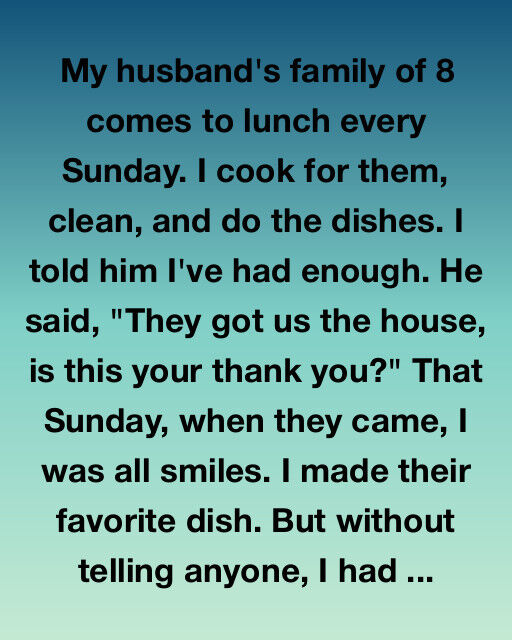
For three years, every Sunday at noon, our house became the family’s gathering place. Without fail, eight people would stream through the door—my husband’s parents, his siblings, their children—hungry, loud, and expectant. It was tradition. I chopped, sautéed, plated, and cleaned while laughter echoed from the living room. I was the hostess, the cook, the dishwasher—and somehow, invisible.
One evening, worn thin and quietly resentful, I told my husband I was done. His response landed like a slap:
“They got us the house. Is this your thank you?”
As if my time, my labor, my exhaustion were a debt I owed for a gift I never asked for.
So the next Sunday, I smiled wide and served their favorite stew—but only one pot. No apron. No second dish. No plate for me. When his mother asked why I wasn’t eating, I said sweetly:
“Oh, this is all for you. After all these years, you deserve the full portion.”
They chuckled—until the food ran out and I hadn’t had a bite. My husband looked embarrassed.
“You didn’t eat?” he asked.
“You all come first, right?” I shrugged.
That night, after the door closed and silence settled, he hissed that I’d made things awkward. I told him I’d felt invisible for three years. No one asked how I was. No one brought dessert. No one lifted a finger.
“I’m not a servant. I’m your wife. I’m their host—not their hired help.”
The next Sunday, I didn’t cook at all. I stayed in bed, watching a movie while the doorbell rang. When I finally answered, I pointed toward the kitchen.
“Bread and butter’s on the counter. Help yourselves.”
His sister half-joked, “Are you on strike?”
“Let’s call it a new tradition,” I smiled.
They ate lightly, stayed briefly, and left quietly. My husband said almost nothing.
A few days later, his older sister called. Her voice was soft.
“We’ve been rude,” she said. “I’m sorry.”
I told her words weren’t necessary—just bring dessert next time.
“I don’t need serving. I just want to be seen.”
The following Sunday, the air shifted. She arrived with a cake. His mother brought a salad. His brother rolled up his sleeves and joined me at the sink. For the first time, the burden wasn’t mine alone.
Still, my husband kept his distance, like I’d rearranged the furniture inside his mind and he couldn’t find his footing.
One evening I asked, “Are you mad?”
He looked down.
“You changed things. It feels weird.”
“I had to,” I said. “I was drowning, and you didn’t notice.”
His voice cracked.
“I didn’t know it was that bad.”
“That’s the problem,” I replied. “You never asked.”
Not long after, his mother invited me for coffee. I braced for judgment. Instead, she surprised me. She took my hand and said:
“When I was your age, I did the same thing. Every Sunday, every holiday—I cooked until my feet hurt. No one thanked me either. I saw myself in you, and I should’ve spoken up.”
Her eyes softened.
“Respect starts with how we let others treat us. Thank you for reminding me.”
The next weekend, she brought the main dish. His sister handled the sides. I made lemonade and, for the first time, sat down as a guest at my own table. My husband sat beside me, not across, and quietly poured drinks. After everyone left, he did the dishes. All of them. Without being asked.
“I get it now,” he whispered. “I took you for granted.”
I didn’t lecture. I just hugged him.
Months later, at a family reunion by the lake, his mother asked who would cook dinner. Before I could answer, my husband spoke up:
“We’ll bring drinks and dessert. Someone else can handle dinner.”
He caught my eye and winked.
That night, on the dock, he pulled me aside.
“I talked to my dad,” he said. My chest tightened.
“About the house.”
Turns out, the down payment his parents had made wasn’t a gift—it was leverage. The deed was still in their name. A quiet form of control.
“We need to buy it out,” he said.
And we did. We cut back, saved, refinanced. A year later, with shaky hands, we signed the papers.
That first Sunday in our house, we ate alone on the porch. Just pasta, a bowl of greens, and silence you could hear.
“Feels different,” he said.
“It’s home now,” I answered. “Ours. Not a debt.”
He reached across the table.
“Thank you for not giving up.”
“Thank you for showing up,” I said.
Weeks later, his sister knocked early on a Sunday, suitcase in hand, eyes red.
“I left my boyfriend,” she whispered. “Watching you… I realized I was settling. I thought love meant doing everything for someone who doesn’t see you.”
I pulled her inside. We made pancakes, laughing as batter splattered the stove. The house felt full again—but this time, full of something new.
Here’s what I learned:
Sometimes the loudest rebellion is kindness to yourself. You don’t need a fight—just a boundary. When you change how you allow yourself to be treated, the right people adjust. The wrong ones fade. And the ones who matter most learn to bring a dish, wash a plate, and ask how you are before they ask what’s for dinner.
Love without respect isn’t love—it’s control dressed up as tradition.
And peace at home begins when you set the table for yourself.