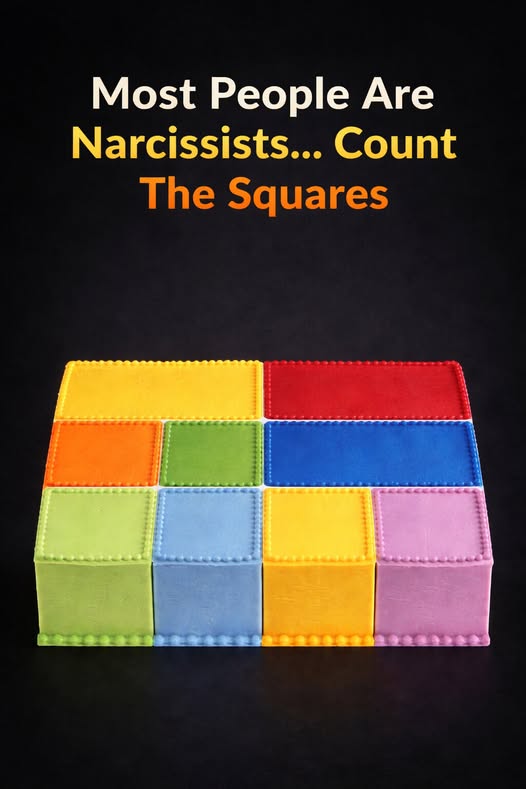
At first glance, it’s the kind of image you’d scroll past and smirk at — a neat stack of square blocks with a caption that dares you: “Most People Are Narcissists… Count the Squares.” It feels like a harmless brain teaser: count what you see, drop a number, move on. But the second you actually try to count, something changes. You realize the “right” answer depends on what your brain decides is worth noticing. Most people answer fast. They count the obvious top-facing squares and commit.
Others slow down and include the front-facing squares too. A smaller group starts hunting for overlaps and partially visible faces, debating whether something that’s “kind of there” should count. That’s when it stops being just a counting game and becomes a tiny mirror. Human perception isn’t a camera — it’s a filter. Your brain saves energy by using shortcuts: grab the clearest shapes first, assume the structure is simple, stop when it feels “done.”
Optical puzzles work because they exploit that habit, turning first impressions into confident conclusions. So when two people give different numbers, it’s not always because one is careless and the other is smarter. Often they’re answering different versions of the question without realizing it: “Count the squares I can clearly see” “Count every visible square face from any angle”
“Count all squares in the whole structure, including hidden ones” The “narcissism” line is bait. It plants a social trigger — miss something and it implies something about you. Once people feel judged, the puzzle becomes about identity, not squares, and the “I’m right” reflex kicks in. This isn’t testing intelligence or diagnosing narcissism.
It’s really testing two things: attention (how much you scan before you decide you’re done) and humility (whether you get curious or defensive when someone sees a different number). If you paste the image, I’ll count it under the most common rules (visible-only vs total) and show the method step-by-step so it’s verifiable.