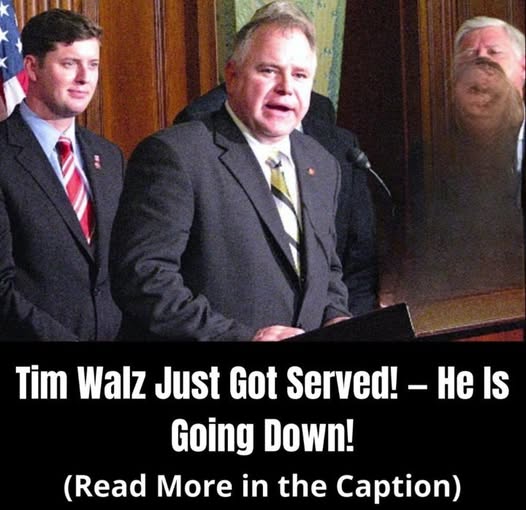
For months now, whispers have been turning into headlines… and headlines into something much bigger. Minnesota has found itself at the center of a storm unlike anything the state has seen in decades. And at the heart of that storm stands Governor Tim Walz — a man once known for calm leadership, now pulled into a widening federal investigation that has the entire nation watching.
It all centers on one of the largest fraud cases in Minnesota history: the Feeding Our Future scandal. A program meant to feed children during the darkest days of the pandemic… turned into a $250 million operation of deceit, luxury spending, fake meal sites, and claims for food that never existed. Money meant for hungry kids was siphoned into cars, vacations, properties, and personal bank accounts.
More than 50 people have already been convicted, and now Congress wants answers — straight from the Governor himself.
When the U.S. House Committee issued a formal subpoena to Governor Walz, everything changed. This wasn’t routine. This wasn’t symbolic. This was a message: There are still unanswered questions, and we need the truth.
The subpoena demands internal emails, warnings, staff memos, state-federal communications, and every document tied to the decisions made before, during, and after the fraud exploded. Because for investigators, one question won’t go away:
How did a scheme this massive happen right under the state’s nose?
And now… the pressure is on.
A FRAUD THAT LEFT MINNESOTA STUNNED
The pandemic opened the door to emergency flexibilities meant to help struggling families. But instead, dozens of individuals allegedly took advantage of the chaos — inflating meal numbers, inventing fake distribution sites, and pretending to serve thousands of children who never received a single plate of food. While families worried about feeding their kids, others were buying high-end cars and luxury trips with money meant for them.
Minnesotans were outraged. Not only because the money vanished — but because it vanished at a moment when vulnerable children needed it most.
GOVERNOR WALZ RESPONDS — AND THE STATE DIVIDES
When the scandal erupted, Governor Walz insisted there was no intentional wrongdoing. He said the pandemic overwhelmed agencies, staff were under impossible pressure, and decisions were made in good faith.
But even Walz acknowledged something painful: “We should have done better.”
Critics say warnings were ignored. Supporters say the federal rules were weak and states were overwhelmed. And in the middle stands the Governor — now forced to hand over documents Congress believes could reveal what really happened behind the scenes.
THE GUILTY PLEA THAT RAISED EVEN MORE QUESTIONS
The case took another dramatic turn when Guhaad Hashi Said — a nonprofit operator linked socially to Rep. Ilhan Omar — pleaded guilty to laundering $2.9 million connected to the scheme. It was the 52nd conviction, and investigators say more are coming.
The plea sent shockwaves through Minnesota’s nonprofit sector. It proved just how deeply the fraud ran… and how many layers investigators still have left to peel back.
FEDERAL PROSECUTORS CALL IT WHAT IT IS: A CRISIS
Acting U.S. Attorney Joseph Thompson didn’t hold back. He said this wasn’t just fraud — it was one of the largest criminal operations Minnesota has ever seen. And it revealed painful weaknesses: poor oversight, overwhelmed staff, inconsistent communication, and emergency conditions that left the door wide open for exploitation.
And while politics rage on, the people who suffered most weren’t in offices or boardrooms.
They were children — the ones who were supposed to eat.
A STATE GRAPPLING WITH BETRAYAL
Parents who relied on free meal programs during lockdown now say they feel deceived. Volunteers say the fraud overshadowed real needs. Community groups say trust has been broken — maybe for years.
Because when $250 million disappears, it’s more than a financial loss. It’s a moral one.
THE SUBPOENA THAT COULD CHANGE EVERYTHING
Legal experts say this moment is extraordinary. Congress almost never subpoenas a sitting governor. Which means investigators believe vital information is still hidden from the public.
Depending on what Walz’s office turns over, several outcomes are possible: public hearings, testimony under oath, new federal laws, more criminal charges, or political consequences that reshape Minnesota’s future.
Walz’s supporters call it political theater. His critics call it overdue accountability. But everyone agrees on one thing:
This investigation is nowhere near finished.
A NATIONAL RECKONING — NOT JUST A MINNESOTA PROBLEM
Washington is now treating this scandal as a warning — a sign that emergency relief programs need stronger safeguards, real-time audits, tighter nonprofit rules, and protections against the kind of vulnerability exposed during COVID-19.
Lawmakers from both parties say reforms are coming. And the lessons written in Minnesota’s pain may shape federal policy for decades.
Because when the dust settles, the Feeding Our Future scandal won’t just be a headline.
It will be a turning point.
THE REAL QUESTION LEFT BEHIND
When all the politics are stripped away, one truth remains:
This wasn’t just about fraud. It was about children who needed help — and didn’t get it.
Families who trusted the system. Volunteers who worked tirelessly. Communities who believed relief was coming.
And now, with investigators circling, documents demanded, and pressure mounting, the nation waits for what comes next.
Because this scandal didn’t just expose financial failures.
It exposed something deeper: what happens when oversight collapses in the middle of a crisis — and the people who suffer most are the ones with the smallest voices.
And now, with Congress watching, prosecutors working, and Minnesota bracing, the future of child-nutrition programs — and political accountability — is about to be rewritten.