Sole Air India Crash Survivor Shares Haunting Story Of Traveling With His Brother
What started off as a typical flight back from a business trip became a nightmare. One man made it through the pandemonium and flames, and his first words were a frantic cry for his brother, whom he was no longer able to see.
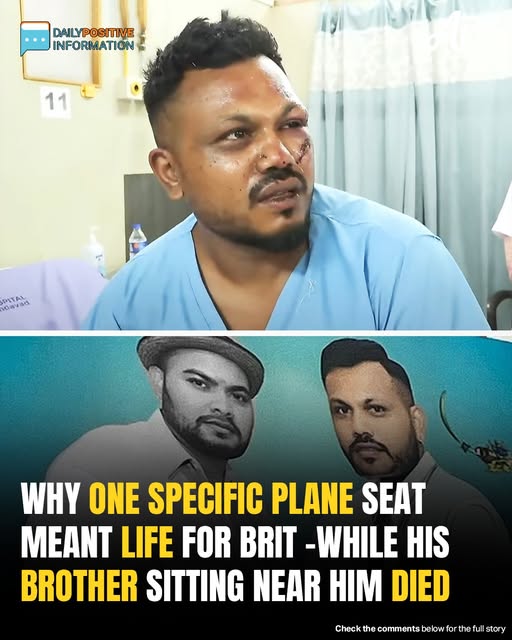
After completing their business trip in India, 35-year-old Ajaykumar Ramesh and his 40-year-old brother Viswash were heading back to the UK. They got on Air India’s flight from Ahmedabad to Gatwick. Unaware of the disaster that would unfold, on Thursday. They sat down, Viswash across the aisle in 11A, next to the emergency exit, and Ajay in 11J.
Then there was a crash.
Viswash survived what investigators now refer to be a catastrophic accident while sat in 11A close to the emergency exit. As the cabin was engulfed in flames, his brother Ajay, who was seated in seat 11J right across the aisle, did not. Bloodied and dazed, Viswash was hauled from the ruins.
Viswash, who is currently in a hospital in India, keeps saying the same eerie request: “Find Ajay, you must find Ajay.”
Their family is torn between sadness and incredulity back in Leicester. Their mother, too upset to talk, is surrounded by family members who are consoling her. Nayankumar, their youngest brother, spoke of the bizarre time they got the call.
“It’s a miracle at least one of them survived,” he stated. “He said his plane had crashed and he couldn’t find anyone. We couldn’t believe it. There was blood running down his face.”
Viswash’s injuries are seen in pictures obtained at the Indian hospital. Desperate for answers, the family is getting ready to board a plane, according to Nayankumar. Ajay’s phone continues to ring, but nobody answers, he added.
Late Thursday night, Air India announced the sobering fact that only one of the 242 passengers on aircraft AI171 survived. Viswash was the only one who survived. Among them was Ajaykumar.
The family held onto hope for hours. They thought that Ajay’s name might have been overlooked in the confusion as he was hurried to another hospital.
As Nayankumar had previously stated, they were “so confused” but hoped his brother had survived somehow. Nayankumar gestured to their mother, Manibai Ramesh, when asked how the family was handling the situation, which involved one brother living while another died. Her cries filled the quiet, but she was too overcome to talk.
“That’s your answer,” he said. “We’re just baffled, baffled.” Despite the heartbreak, he acknowledged the cruel duality of the moment: “It’s a miracle at least one of them survived.”
Viswash and Ajaykumar had visited India on business related to their family’s businesses. Previously, Viswash was the director of RMV Fashion, a textile company based in Leicester that shut down in 2022.
When Viswash called home, the first indications of life appeared. He informed family members that he had escaped the burning plane and was hurt but unharmed. Although the call was a relief, it also made Ajay even more terrified, and he never called.
Their cousin, Ajay Valgi, also from Leicester, shared his anguish. He described Ajaykumar not just as a cousin, but as one of his closest friends. “They were sitting next to each other,” he said. “But we don’t know what happened to Ajay.” The family is still reeling. “We’re not doing well,” he added. “We’re all upset.”
As we previously reported, Air India Flight AI-171 crashed shortly after takeoff on Thursday afternoon, June 12, 2025, in Ahmedabad, leaving the nation in shock and grief. While travelling to London Gatwick, the Boeing 787 Dreamliner, which was carrying 242 passengers and crew members, unexpectedly ran into problems.
Just before all communication with Air Traffic Control (ATC) was lost, Captain Sumeet Sabharwal, who was in charge of the aircraft, sent out an urgent Mayday call, the most serious emergency signal in aviation.
The pilot’s last transmission before the plane disappeared from radar was the globally recognised distress signal, “Mayday, Mayday, Mayday,” which must be repeated three times for clarity and priority treatment. The Directorate General of Civil Aviation (DGCA) stated that no additional reaction from the cockpit occurred despite numerous attempts by ATC to reconnect.
The plane struck the Meghani Nagar neighbourhood, a five-million-person residential area outside the airport’s boundaries, at around 1:39 p.m. IST. Five minutes after departure, the event happened.
Flames erupted at the scene of the jet crash, and soon after, dense, black smoke enveloped the entire skyline. As soon as they arrived on the scene, emergency reaction teams began a rescue effort amidst the debris.
Even the word “Mayday” has a moving history. Frederick Stanley Mockford, a radio officer at London’s Croydon Airport, came up with the term in the early 1920s. It comes from the French word “m’aider,” which translates to “help me.”
By 1927, the International Radiotelegraph Convention had accepted the phrase as the official spoken distress call for ships and aeroplanes worldwide, in addition to the Morse code “SOS” signal.
Mayday calls are used by aviation specialists to alert pilots of the most catastrophic events that may occur while in flight, such as engine failures, structural issues, fires, extreme weather, or significant medical situations. Less serious distress calls, such as “Pan-pan,” which deal with technological issues that don’t immediately threaten life, are not the same as Mayday.
Key information such as the aircraft’s name, location, emergency type, number of passengers, fuel remaining, and assistance needed are usually included when a pilot initiates a Mayday call.
Emergency responders and air traffic controllers can act quickly and efficiently thanks to this organised style. All non-urgent radio conversations are stopped upon receiving a Mayday call, giving the troubled aircraft top priority.
To offer complete support, ATC then works with emergency services, other planes, and other airports. In order to improve the efficacy of rescue operations, the Federal Aviation Administration (FAA) also recommends pilots to provide precise information such as weather conditions, altitude, and flying intentions.
The crew’s prompt and precise Mayday call was an essential part of adhering to emergency procedures in the recent Ahmedabad tragedy.
Despite the unfortunate outcome—no survivors are known—the message provided investigators and emergency agencies with important information, demonstrating the aircraft crew’s professionalism even in the most dangerous situations.
The wreckage of Air India Flight AI-171, which had been fully fuelled just prior to takeoff and its devastating crash, was engulfed in flames that firefighters battled valiantly to put out. Additionally, nearby multistory buildings were doused with water; one of them had the plane’s tail cone still stuck close to its roof, its stabiliser fins clearly destroyed.
Horrible scenes characterised the immediate aftermath: burned carcasses were strewn all over the ground, and one was gravely removed by rescue personnel.
In a public speech, British Prime Minister Keir Starmer addressed the incident and conveyed his sadness, describing the accident sights as “devastating.”
Indian Prime Minister Narendra Modi also expressed his sympathies to everyone impacted by the incident, calling it “heartbreaking beyond words.”
Indian television news outlets said that the plane had hit a medical college dorm’s dining hall. At least five medical college students were murdered on the ground, according to Divyansh Singh, vice president of the Federation of All India Medical Association. Fifty more were hurt, some critically, and more were “feared buried in the debris.”
The Indian Army sent personnel to help clear debris and treat the injured as part of the relief and medical assistance efforts that were in progress in the wake of the disaster.
Natarajan Chandrasekaran, the chairman of Air India, underlined the airline’s dedication to helping all impacted people and their families. To guarantee that the bereaved received timely information and care, he pointed out that emergency centres and support teams had already been activated.